
When I joined Nana Trend Lestari, one of the first problems I noticed was simple but critical: Shopee Ads were spending money—but not spending smart.
The brand ran ads without segmenting intent, product roles, or funnel layers. All products were treated the same, and the algorithm had no clear direction on what to scale.
The result?
ROAS was stuck at 4.66x, and cost efficiency gradually declined.
I knew the problem wasn’t the product, the market, or even the budget.
The problem was structure.
And in Shopee Ads, structure determines everything.
Shopee Ads work fundamentally differently from Meta or TikTok.
There are no custom creatives, no video formats, and no storytelling hooks.
Your product listing IS your creative.
Meaning the only way to improve ROAS is by controlling:
What you push
To whom you push it
At which buying intent
With how much pressure (budget)
Before I optimized the campaigns, everything was blended into one structure—Discovery, Search, and Targeting Ads were running without a clear intent hierarchy.
And because there was no segmentation, the algorithm had no signal about where conversions truly came from.
So I rebuilt everything from zero.
Instead of running broad campaigns, I separated products into three layers that matched real buyer behavior on Shopee:
Pushed entry products and hero SKUs with strong CTR
Target: users browsing Homepage / Similar Products
Goal: maximize cheap exposure to feed remarketing layers
Targeted mid-funnel customers actively searching category keywords
Focus on products with stable conversion history
Increased bidding only for relevant keyword clusters
Retargeted users who viewed the product or added to cart
Prioritized items with strong CVR and price competitiveness
Stabilized conversions with minimal wasted spend
This simple restructuring instantly clarified the algorithm’s direction:
TOFU for traffic → MOFU for consideration → BOFU for conversion.
To ensure the system stayed efficient, I focused on:
Shifting budget toward high-CVR SKUs
Reducing waste on non-performing variations
Monitoring peak hours of cost efficiency
Adjusting bids only where conversion intent was proven
Turning off products that cannibalized each other
Instead of chasing volume, I chased profit per click.
This approach helped prevent “volume traps”—high spend but low revenue—and moved Shopee Ads into a profit-first operating mode.
After restructuring and continuous optimization, the results were clear:
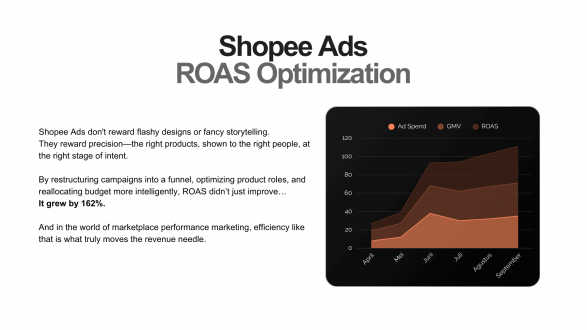
ROAS increased from 4.66x → 12.25x
CTR improved from better visual-product alignment
Conversion efficiency increased as funnel targeting stabilized
Budget waste dropped significantly
Shopee Ads finally worked the way they were meant to—intent-driven, product-aligned, and conversion-focused.
This wasn’t magic.
It was simply giving the algorithm the structure and clarity it needed.
Shopee Ads don’t reward flashy designs or fancy storytelling.
They reward precision—the right products, shown to the right people, at the right stage of intent.
By restructuring campaigns into a funnel, optimizing product roles, and reallocating budget more intelligently, ROAS didn’t just improve…
It grew by 162%.
And in the world of marketplace performance marketing, efficiency like that is what truly moves the revenue needle.
Objective:
Increase ad efficiency through segmentation and continuous performance review.
Actions:
Results:


